

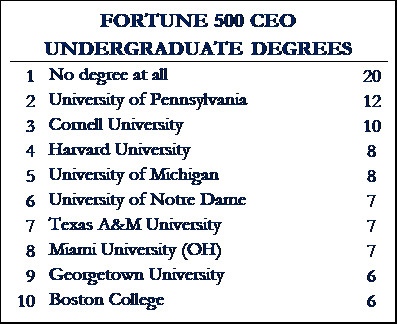
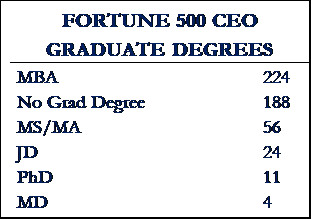
If you’re looking to make a few bucks or start a bar fight at your regular watering hole in Manhattan, I would recommend betting all comers whether they might be able to name the college from which the greatest number of Fortune 500 CEOs graduated. The answer, simply, is no college at all. It is, granted, a small number at 20, but it is almost double the representation of UPenn, Harvard, and Cornell, respectively. A stunning 291 discrete undergraduate institutions are represented in our annual survey of the educational credentials of the country’s biggest titans of industry.
There was a time in my life, when I was closer to college age myself, when I would have been incredulous to see these statistics. I remember becoming positively apoplectic after reading some comments from Peter Thiel, himself a product of Stanford University and Stanford Law, when he suggested in the 1990s that a degree from an “elite” (i.e. expensive) college was not worth the cost. His book, The Diversity Myth, co-authored with David O. Sacks seems shockingly prophetic today, as was Allan Bloom’s The Closing of the American Mind published a decade before it in 1987. For the children of aspirational working and middle-class parents in the 1980s, such thoughts were often considered heretical. But over time during my business career, I started to realize Thiel was simply ahead of his time, seeing something in the system of higher education that so many of us had missed.[1]
[1] The Thiel Fellowship gives young entrepreneurs $100k to drop out of college for two years to pursue an idea or start a company.
Working for Ed Hyman, the greatest sell-side analyst of all time by any objective measure, at his start-up in 1991 taught me, in the end, how little it all mattered for those pursuing a career on Wall Street. Ed created a true meritocracy, and it didn’t matter whether you had graduated from a small and largely unknown midwestern college or from the Ivy League on the East Coast. A lot like professional sports, hard work, passion, and performance were the only things that mattered to him. The rest was just conversation. In the process, he built a world-beating company based on common values and ways of doing business, rather than credentials.
All this came rushing back to me in the last week as the internship season in New York started in earnest and my son returned home after he graduated from college four weeks ago. For the past 10 years, Strategas has hosted a conference for interns every summer where we discuss what the various parts of our business – research, sales, sales trading, and asset management - do and also what life is like on Wall Street In speaking with many of them over the years, it is clear that so many are, in some way, wondering whether they were choosing the right path and if the standard and fixed markers of success that had guided their young lives to this point were going to be relevant to their future.
We’ve all been there, of course, but in the process of hosting this conference for the past ten years, I am finding college kids increasingly unsure about not only what they want out of life but also whether they have the skills necessary to build a successful career on Wall Street. I find this a bit sad, given the blood, sweat, tears, and money they have expended to attend college and find themselves at a fancy-pants conference. This phenomenon also angers me to some degree because it suggests that there are adults who should know better who are telling them - out of either self-interest or a sense of self-importance - that a successful career in finance requires a lot more than character, a penchant for hard work, and an intense interest in learning something new. I love this industry and think that it must be among the more intellectually stimulating professions one might choose, but I find the idea that it requires some sort of special intellect to be laughable.
Of course, the number of CEOs a college or university produces is not the full measure of the value of the education one might receive there. But for the young person seeking a career in business, especially those not to the manner born, the results are telling. In the fullness of time, I concluded that Thiel’s comments were so disturbing to me due to the sacrifices my parents and I made financially to attend prestigious schools. In the end, only call options on Ariba during the dot.com boom relieved me from student loans and a negative net worth in my late 20s.
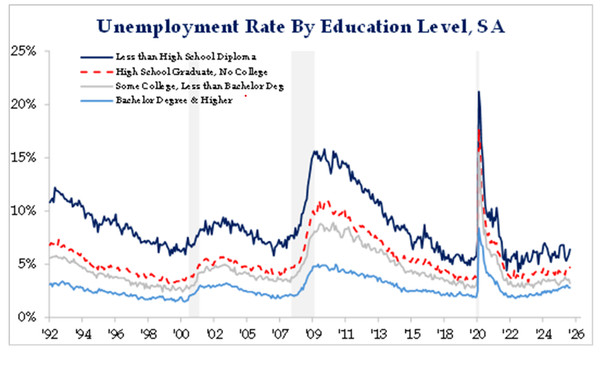
This is not to dispute the value of a college education, only what it might cost. The data are clear that those possessing a college degree earn more over their lifetimes than those who don’t. As I got older and became a parent myself, I came to realize that the classical education I received with a core curriculum in literature, history, theology, philosophy, and the humanities was critical to my development as a person and my search to understand the world around me. Of course, in those days, no one felt the need to “deconstruct” or “reimagine” these core building blocks of a classical education. Shakespeare and Dante were not the product of an “oppressor class,” they were simply the greatest poets in history and that was that.
I asked the intern who did the hard work for this project (a young man from Manhattan) what he thought about the results. He said, “the only industry that seems to be really hung up on Ivy League credentials for upper management is financial services. This pattern does not hold up really in any other business. Overall, it’s interesting to observe that the finance industry cares so much about university ranking while other companies with CEOs and employees from less prestigious universities outperform them. Maybe they are focused on the wrong things?” Out of the mouths of babes. What would Ace Greenberg say? The analysis also suggests that big things can come in small packages. Out of Peoria, Illinois, Bradley University, with an endowment of $400 million, is responsible for three CEOs in the Fortune 500. Yale, on the other hand, has an endowment of $44 billion, and is the alma mater of two Fortune 500 CEOs.

In the field of economics, education has long been known as an example of a “Veblen good” in which consumer demand increases as its price increases. The demand curve for Veblen goods is upward sloping, in total contrast to a normal demand curve, due in large part to assumptions about quality and the good’s association with status. As a thought exercise for this project, I grossed up what I remember to be the total costs of tuition, room, and board my senior year by the rate of inflation. This simple analysis suggests that the same “product” should cost about $51,000 today – a princely sum to be sure, but significantly less than the $95,000 price tag per year the school carries today. It seems as if many of us – parents, alumni, college administrators, and employers – have lost sight of the true value of a college education.
As a final thought on Thiel’s insight, it is reported that he was greatly influenced by philosopher René Girard’s mimetic theory, which simultaneously acknowledges the productive potential of competition and the potential for competition to stifle progress once it becomes an end in itself. Said Thiel: “(t)he big problem with competition is that it focuses us on the people around us, and while we get better at the things we're competing on, we lose sight of anything that's important, or transcendent, or truly meaningful in our world….Before getting swept up in the competitions that define so much of life, ask yourself whether you even want the prize on offer. Look beyond the tracks laid down by academic specialties to the broader future that is yours to create.”[2] Sage advice for young and old alike indeed.
[2] Peter Thiel, “The Competition Myth,” Intercollegiate Studies Institute, July 24, 2015.

